
Print a Sign-In Sheet | Spanish Version Coming Soon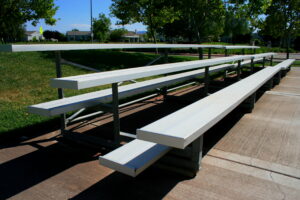
Bleachers are a common feature in schools. Most schools have bleachers in gymnasiums, auditoriums, stadiums, and at athletic fields. Over 20,000 bleacher-related injuries occur annually in the United States. Most incidents involve falls caused by poor maintenance or lack of guardrails. Legal liability for schools can be severe if negligence is proven.
Common Safety Risks
- Loose or missing bolts and hardware.
- Rust or corrosion on metal components.
- Cracked or rotting wood.
- Inadequate guardrails or handrails.
- Improper spacing between seat boards and footboards.
- Poorly functioning retractable mechanisms (for telescopic bleachers).
- Cracked or broken welds.
- Bent or warped benches.
- Sharp metal edges.
Maintenance (Best Practices)
- Follow Consumer Product Safety Commission and International Code Council (ICC 300) guidelines.
- Make frequent inspections of bleachers. Quarterly inspections should be performed by properly trained staff members to look for any defects and potential issues. Bleachers must be inspected once every 12 months by a qualified person.
- Develop a maintenance logbook for bleachers.
- Bleachers should be level and not leaning.
- Make sure there are no cracks or broken welds on frames, joints, and braces.
- Tighten any fasteners, nuts, and bolts, as needed. These can loosen or crack over time.
- Make sure there are no trip hazards on floorboards or steps.
- Handrails and guardrails, end rails, and rails on stairs should not wobble or have loose connections.
- Seating surfaces should not have any sharp edges, gouges in surfaces, uneven or mismatched connections.
- For bleachers that are movable, wheels and moving mechanisms should be in proper working condition.
- If bleachers include electrical components, inspect junction boxes, harnesses, switches, wiring, and conduit for signs of damage, wear, or corrosion. Moving parts and motorized functions should have the proper guards and covers.
- Train custodial and athletic staff to watch for potential issues.
- Use only manufacturer-approved parts for repairs.
- Address issues immediately — DO NOT delay repairs.
Additional Safety Tips
- Staff members with proper training should set up and operate bleachers.
- Never allow children to climb on the bleacher guardrails.
- Store bleachers while not in use.
- Aisles, handrails, nonskid surfaces, and other items that assist in access and egress should be incorporated and maintained as feasible.
- Make sure bleachers are ADA compliant.
Bleacher safety is the responsibility of all trained staff members. Regular inspections, proper maintenance, prompt reporting of issues, and timely repairs are essential for safe and efficient operations.
KEMI does not assume liability for the content of information contained herein. Safety and health remain your responsibility. This information is to be used for informational purposes only and not intended to be exhaustive or a substitute for proper training, supervision, or manufacturers’ instructions/recommendations. KEMI, by publication of this information, does not assume liability for damage or injury arising from reliance upon it. Compliance with this information is not a guarantee or warranty that you will be in conformity with any laws or regulations nor does it ensure the absolute safety of any person, place, or object, including, but not limited to, you, your occupation, employees, customers, or place of business.
